013_Penduka, and a little help from my friends

Post Title: 013_Penduka, and a little help from my friends
Written Date: 10 Dec 2015
Posted Date: 11 Dec 2015

First a little about Penduka, then a request – an important one – at the bottom of this post.

Penduka is big, complex, and an honor to work with. Penduka Village is at Lat -22.526440(S), Lon 17.015542(W). Look it up on Google Earth by entering “Penduca Craft” (it is misspelled in Google, but that will find it). It is on the shoreline of the Goreangab Dam Reservoir, one of the drinking water sources for Windhoek, the capital of Namibia.
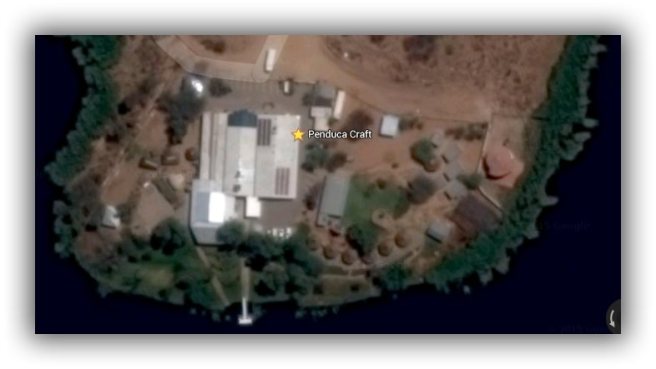
Penduka_Google Earth

The little silver square at the bottom left is the roof of my home. The big square(ish) building houses a restaurant, kitchen, terrace, dormitory for 7 women that live here, a large conference room, a workroom for batik (I’ll show you that in a later blog), a room where about 15 women sew using up to date Singer industrial machines just given to us by the Namibian Government, two kilns and a room where pottery is made and hand decorated, a little bit of office space, and a store room for inventory. On the roof on the right of that big building you will see two sets of solar arrays – insufficient, and donated by (I think) the Spanish government, but welcomed. Our electricity bills are enormous mostly due to ineffective three phase power distribution lines that just grew, unplanned, as the site grew over the years. It can be fixed, but it will cost – and we don’t have the money. The greyish roof in the middle left to right and slightly below center vertically is a room where deaf women make glass beads out of recycled bottles, and where 35 women from the surrounding community (Katutura) and about 150 women from the rural areas around Oshiwarongo (about 2 hours north of Windhoek) gather periodically to deliver embroidery work they do on a piecework basis. Penduka employs 31 women who work here regularly (24 of whom are bussed in and back every day from the community), and four men who are the guards and grounds keepers, and all four of them live here. And I live here.

It’s not exactly your “hut in the bush”, but it is resoundingly African. Not the African I took for granted with roaring lions, elephants, giraffes and water buffalo wandering around but the very real Africa of today, including highly venomous snakes! In the six months I’ve been here I’ve killed two Puff Adders and helped capture a 1.6 meter Black Neck Zebra Cobra (spitting cobra). Not unusual for Namibia. And it is incredibly beautiful. Here is a shot of my house from the water.
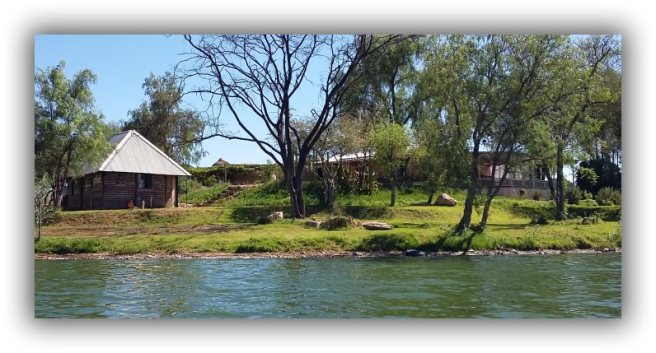
Bottle House from the water

The building on the left is my house, and you can see the bigger production/restaurant building through the trees on the right side. This is about 1/4 of the waterfront.

The purpose of Penduka is to support low income, underprivileged women in Namibia with a priority for helping disabled women. Of the 31 women who work here, seven are deaf. Yes, I’m learning some sign language. It’s the only way to communicate with them!

Penduka is a registered welfare organization and a Non Governmental Organization (NGO) – for sure one of the oldest, possibly the oldest, such organization in the Republic of Namibia, which is 25 years old as an independent country this year. Penduka is 23 years old, and for the past several years have been barely scraping along due to lack of good internal management. That’s why they requested a Peace Corps Volunteer, and got me. I am honored to be here, and totally and completely overwhelmed with the work.

When I got here, I did the normal thing of making lists of “stuff” that needed to be done. So let’s look at the business that goes on here. The hospitality section runs a restaurant with full kitchen, six “rondelles” or guest lodges, five “backpacker lounges” with five beds each and external toilet/shower facilities, a convention center, and cultural dancing for tour groups. The Penduka Village Artisans are the women that produce batik, embroidery, sewing, pottery and bead work. The Hospitality section also runs a brand-new “pedal boat” business (we just got the boats donated last month by the Turkish Embassy) that we’re still trying to get going, a large garden that was just restarted two months ago from being dormant, and a poultry house/egg farm with currently about 100 layers, but they are starting to die off and get unproductive. You’ll see more on the egg farm at the bottom of this posting – please make sure you check it out.

Just last week, we were approved to be the first installation of an “Aquaponics” facility that has been in development by the Finnish Government through an NGO “Fish Farmers of Namibia”.  We will be raising Talapia fish in a 1 cubic meter tank, using the water to flood seven or eight 1 meter square gardens filled with gravel and/or charcoal where the algae and bacteria convert the fish water nutrients into nutrients useable by vegetables (spinach, lettuce, tomatoes, etc.) and the water flowing through the gardens is recycled through the fish tank. We will use the vegetables in the restaurant, maybe sell some of them, and use/sell the fish periodically for food when they are replenished by fingerlings (baby fish). We will also have a “domestic” unit that is one cubic meter total, and has the vegetable garden on top, the fish growing below, and is designed to be in someone’s back yard, providing food for a family or a neighborhood. The community around here is very, very poor and nutrition is a real problem. This project is entirely funded for installation, and when it is completed in early January we will start running it to develop the bacteria, and then start raising vegetables probably in early March. This is a VERY exciting project. We will train people, hopefully find funding to distribute “domestic” units, and supply food to the Katutura community.
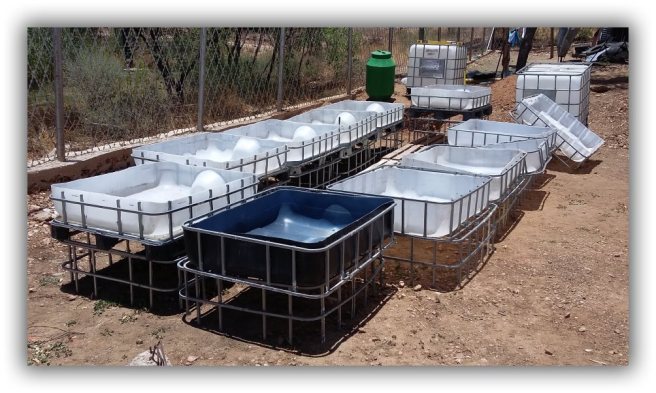
Aquaponics_4 Dec 2015

Aquaponics just starting installation. The entire setup will be under shade netting.

The culture here can be frustrating if your goal is to get something done. The people here are also frustrated by it. But things just simply don’t work as well – why? That may be the subject of a future blog. I certainly don’t understand it although I do have a few theories that I think account for a good portion of the effect, and well-meaning people in country and from abroad have been trying to make some impact on it for hundreds of years. I doubt if I’ll have a good way to describe it to you, or to try and fix it (the mistake a lot of people have made). But I came to the conclusion after a few months that the most I can possibly do is to help the women who need to run this place start to develop some new skills at the top, and THEY can try to train and help the rest of the organization because they understand the culture, and communications, much better than I can.

So – essentially I am a mentor. We picked four women who “get it”, and know they don’t have the training or skills, but want to develop them. They are getting better and better – running meetings, understanding schedules, and doing the basic stuff the leaders and managers do. But they still don’t understand percentages well, have trouble with what I consider basic math (averages, multiplication, and “per unit” measurements), and it gets worse with the women in the Artisan section. Their skills are fantastic, and they are smart, but their understanding of basic life and financial skills is astoundingly low or missing entirely. It is an enormous challenge.

I have nothing but respect for the Peace Corps system of Development – one person at a time, from the inside. We are encouraged to the point of being required to develop relationships, to get to be part of the community, and to make whatever skills and education we have available to the local folks so THEY can make the difference. It’s great, it’s slow, and it’s enormously rewarding and effective in the long run. It is, indeed, “The hardest job you will ever love.” I am so very happy here, and so very overworked, and in tears with frustration some evenings, and giddy with small successes on occasion. I enjoy this more than anything I’ve done – ever – I think. (Although flying fighters was pretty fun, as was acting. I can honestly say this is the first business job I’ve really just plain enjoyed.)

So if it’s this big, and does so much, what’s the problem?

Over the past many years, the managers here have been brought in, were often not Namibian, and were often either incompetent or larcenous, or both. Or well-meaning but just did stuff themselves instead of really trying to teach the women how to do it and make it sustainable. Frankly I have a lot of empathy for that – it is very, very difficult to change a culture. As a result, the last General Manager (several years ago), for instance, left taking all of the poultry farm expertise with him, together with a lot of equipment, information, and knowledge. Not good. And left the rest of the organization in relative tatters.

Also, for similar reasons the “training” mission has fallen by the wayside, and the mission/vision of Penduka has become muddy and not clear at all. And it shows in the organization. Last week I did a Vision/Mission training session for the senior managers, and they provided very good response. They have some idea why it is important for everyone to see the same forward vision, at least partially. It’s a start.

Penduka has been operating on a shoestring for the past few years, and struggling to make payroll. And the women here earn just barely over subsistence level income for Katutura, which has one of the lowest income averages in Namibia, which has one of the lowest income averages in the world. There are some very wealthy people here, but Namibia also has one of the highest income disparity measurements in the world (although believe it or not, the United States is catching up! Not opinion, fact.). And some of the poorest work here. And they are fantastic people, but I’m already at four pages in this blog, and will have to come back to this topic.

I was raised by a clergyman, spent my early years in churches in very rich and very poor areas of the South, and I had no idea what it was like to be really poor. That is changing, here. One of the greatest things in my life is becoming accepted as a “family member”, the only “Tate” (pron: “Taa te” where te is like the ta in table. It means man, father) in this family of women. In the past six months I’ve started to become accepted – a member of the family – and it is amazing. Theft and hitting up the American for money is widespread in Namibia, but not here at Penduka. In six months, I have had one, only one, employee who has asked me for anything. The people here will go out of their way to pay back a very small amount when I purchase something for them at the pharmacy or store while I’m in town. And theft here at Penduka is unknown at least internally. We have an environment where we can, and are, making a difference in women’s lives, and trying to set them up for success and self-confidence. And they are helping as best as they know how.

My project over the next three weeks (during the Christmas break – I’m staying right here) is to come up with a business plan for a 3-5 year concept for Penduka that has been informally accepted by the Board of Trustees and the Founder, and the General Manager here.

Now that we have a plan, I am asking for some help from anyone reading this blog. Just a little bit right now while we take small steps to success.

THE POULTRY RESTART PROJECT – We need to add 150 new chicks and a little equipment to our poultry operations here to make them self-sustaining. After that the poultry farm will make a little bit of profit, but also be able to feed people here and in Katutura with fresh eggs (including me!) and selling chickens for meat twice a year. Once we get this going, it will cycle, be sustainable, and will no longer require financial help.

Can you please help out the women of Penduka by helping us fund this poultry restart project? It’s not much money, and you can donate through the U.S. Peace Corps Web site https://donate.peacecorps.gov/donate, select “PROJECTS AND FUNDS“ in the middle of the page, and search me out by name, or by country (Namibia). The direct link to my project is https://donate.peacecorps.gov/donate/project/village-egg-farm-restart/#amount-form.  We don’t get the money until the amount requested from donors (hopefully you!) is raised, which is only $488.89 in US Dollars, so be generous if you can. The Penduka community is supplying $245.19 (33.4%) of the total amount of $734.08 needed. This is N$9,910 Namibian Dollars – a LOT of money in Namibia!

We need to buy and start raising the chicks very quickly to catch the seasons right, and to replace the aging hens that are currently laying. Their egg production rate is dropping, and new chicks don’t start laying for at least six weeks after we get them.

100% of this goes directly to the project, and 100% of the profits of Penduka goes to the women who work here. NOTHING is paid to the Board of Trustees (they are all Namibian, active, and unpaid volunteers), and the Board owns 100% of Penduka. It is corruption free. I am very, very lucky to have this unusual assignment in Namibia.

So please – visit https://donate.peacecorps.gov/donate/project/village-egg-farm-restart/#amount-form and contribute whatever you can. I promise I’ll post pictures of gobs of really cute little chicks peeping all over the place before we steal their eggs and eat them. (Sorry, I couldn’t resist!)

More blogs soon. There is just so much to talk about.

Andy


013-Happy Thanksgiving

Title: 013-Happy Thanksgiving
Written: 26 Nov, 2015
Posted: 26 Nov, 2015

Happy Thanksgiving, everyone! It is a holiday that doesn’t exist in Namibia, but many of my Peace Corps friends got together (or will, tomorrow) to socialize and celebrate. It is my favorite holiday in the USA. I’ll miss cooking with my family, but I’m confident they will do well with the Turkey even if I’m not there!

I’ll also miss making mashed sweet potatoes with marshmallows with my daughter, but am making a small helping here just to feel like I’m sharing it with her.

Today was really, really busy and very tiring, but a good day. We had three professional photographers at Penduka taking photos for the new brochure I’m designing with Josine, my Dutch colleague. Early indications are that the photographs will be OUTSTANDING and I’m really excited about it. When I get them, I’ll post some.

Not much to say this time – just wanted to wish everyone a Happy Turkey Day! I’m ten hours ahead of California and it’s Thanksgiving evening here. I’ll SKYPE with my family when they gather for dinner which will be tomorrow morning my time.

I intend to write another blog this weekend with more substance, and pictures. This note was just about Thanksgiving, or the lack thereof in these neighborhoods!

012_What is it like in Namibia – # 1

Post Title: 012_What is it like in Namibia – # 1
Written Date: 8 Nov 2915
Posted Date: 8 Nov 2915

I’m sure there will be other entries on what it’s like, here, so this is “# 1”.

Namibia (population 2.3 million at the most –  it’s unclear) is almost exactly twice the size of California (population 38.8 million as of 2014). I’ll save you the math: California has 34 times the population density! Imagine an economy in a country twice the size of California with 1/34th of the population density. More people live in Houston, Texas, than life in ALL of Namibia. Namibia has one of the world’s most uneven income distributions (search GINI index for Namibia). There are a very few very wealthy people, a few well to do people, and a LOT of very poor people.

And it’s dry – very, very dry. One of the most arid countries on earth in fact. I hang clothes inside my house to dry, and they are almost always bone dry in an hour, even at night. Yet it can be very hot and very cold in the same 24 hour period. Generally it is temperate here – much more pleasant than I anticipated from the luxury of the San Francisco area. The climate chart below gives a pretty good picture, but in the last 3-5 years there hasn’t been as much rain as shows on the chart.

(click on the link).Windhoek Climate

——————————–

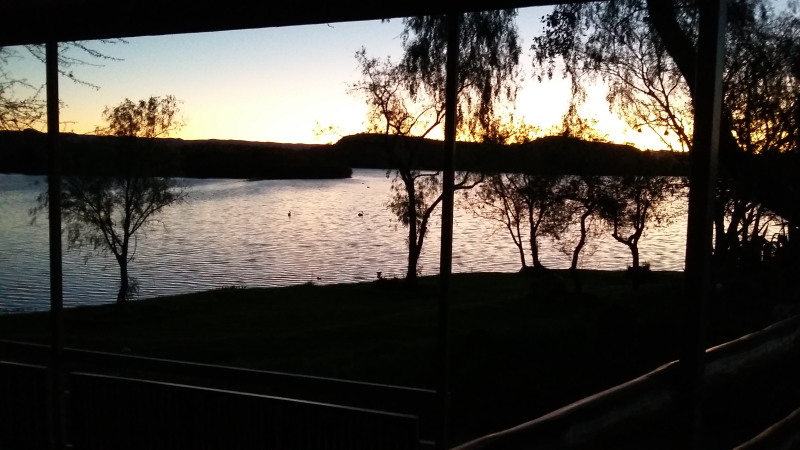
It’s now three hours later than the last sentence. I met a colleague here at Penduka from the Netherlands and we just spent almost three hours talking on the terrace while the sun set, the Pelicans moved slowly along the lake, the Coots and Grebes chased each other around on the water, and the light took on a magical sunset feel that made a tree literally glow next to the water, The overall sense was surreally beautiful. When it got completely dark, my “bottle house” resembled a fairy tale home on the side of a lake, lights showing through the curtains in the windows and sparkles coming through the walls from the light inside. We started making comparisons to “Hansel and Gretel” and imagined a large pot full of children  simmering on the stove. But somehow it was magical.

All I had was my phone camera, and it doesn’t do the pink sunset justice.

Sunset at Penduka

This was an Africa evening – something I cannot quite describe and yet have come to appreciate in a way I never thought possible – and I’m used to some really spectacular settings. In spite of the challenges (and I’ll write about those also, eventually. Not tonight.), there is a sense of peace and harmony with nature here that is … African. As Josine (my Dutch colleague) said, “I am beginning to understand why people fall in love with this place.” Me too.

A land of contrasts, sure. Poverty on a scale that is vast in a way that is hard to understand. Scarce populations and a nation trying to build itself on the shoulders of way too few people. 25 years ago, when Namibia became a nation after well over a century of oppression and colonialism, it was handed an infrastructure that was complete – roads, electricity (power), water, and the fundamentals of business all thanks to the Germans and South Africans who built it up for their own profit. But the black Namibians had never been encouraged or even permitted to understand how to work with the economy, to cooperate, to build and be accountable; To have pride in themselves. Sure, there were exceptions, and some of the Namibians are rising to the challenge really well. But the poverty limits many, many of them. Yet they are some of the most positive and friendly people I’ve met anywhere in the world. And yes, there is a lot of crime here.

Land of contrasts – it’s an understatement when applied to Namibia.

I don’t make any claim to being able to compare this place to all of the USA, much less the rest of the world. I just barely scratched the surface of understanding Penduka Village, and that’s 35 people (about 250 total for Penduka throughout Namibia) out of 2.3 million, and a land area of one hectare (Penduka Village) out of the entire country. I don’t make any claim to understand all of the USA. I have lived, worked, or traveled in every state except Alaska (I’m not done yet! I may be able to visit my daughter there when she’s in the Coast Guard. I hope so!). And I certainly don’t claim that Penduka/Namibia is better than anything I’ve experienced anywhere. But it is a Namibian/African “flavor” that is unique. Of course Sausalito is unique, as is Topeka, New York, Ottumuwa, and every place else. In some ways it is special to me because it isn’t something I grew up with – it’s still “exotic”, but at the same time strangely familiar. People are people, wherever they are. And the buildings in Windhoek look very much like the buildings in any reasonably large town (Windhoek population approximately 300,000). I occasionally look around and remark to a companion “you know, we are in AFRICA!” But aside from the cultural newness, this place grows on you, gets into your very being, in a way that is new to me. And I feel like I can finally understand what so many authors have said about Africa.

My Dutch colleague was saying that in The Netherlands, people from Africa (and other countries and continents) are referred to as seeking the easy life, and are derided as trying to just find an easier way. They only come to take advantage of the better way of life. I hear similar things from some people in the USA. We agreed that they don’t have any idea. The people from Namibia that have the money, and the frame of mind, to go to another country are the winners, the people who have succeeded here and who want a chance to do even better where the opportunities are greater. They are moving to Holland and the USA, and other places, for the same reasons the original people from Western Europe moved to the United States in the 1700’s. It is a different world than the one they moved in 300 years ago, but the types of people are the same. But to us, in an established country, they are, to put it harshly, losers. And it’s so wrong. I know some people here who want very, very badly to move to the USA, or Western Europe, and they are still trying to pull the money together to do it. They are worlds ahead of most of the people here who drive a taxi to feed their families if they can manage to get off the farm, and out of the village, to begin with. Unemployment in Namibia is (I’m beginning to sound repetative, but it’s true) one of the worst in the world. (Almost 30% for Namibia, higher in Katutura.71% percent of the population in Katutura’s informal areas live below the subsistence level of N$860 – less than US$ 64 – per month)  I would welcome these people as neighbors any time. My country, the USA, was shaped by people just like that.

Here are some of the women at Penduka I work with. They are looking at a book of pictures of Penduka from about 10 years ago. I know them all personally, and they are rich and wonderful souls. Left to right: Martha, Helane, Leude, Jennifer, and Lydia.

Martha Helane Leuda Jennifer Lydia

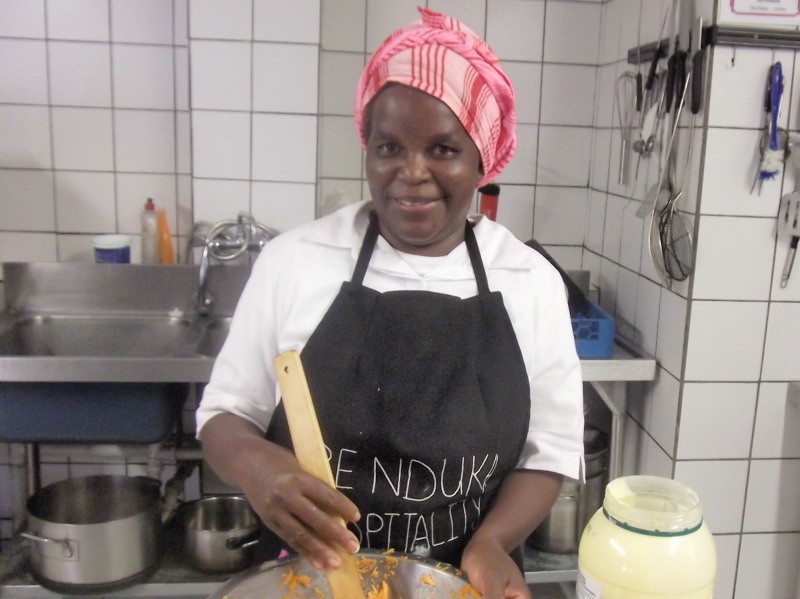
This is Liina:

Liina

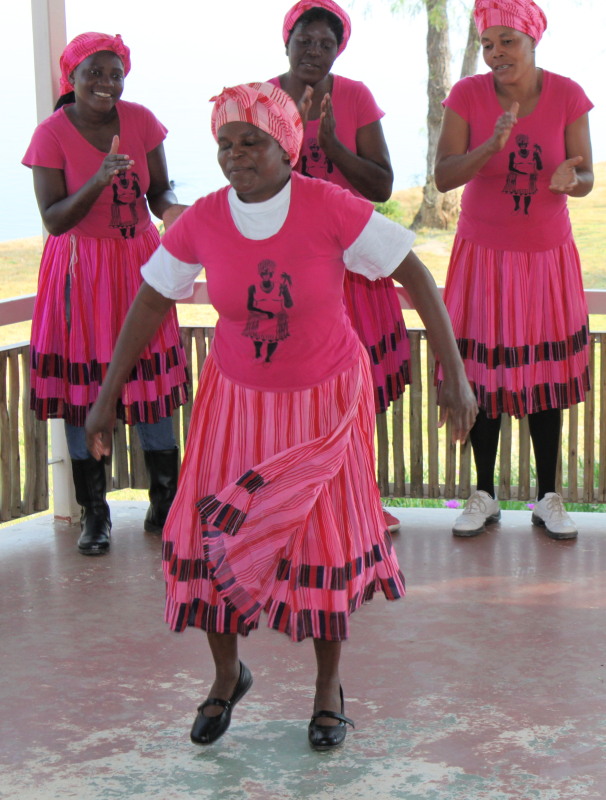
Liina is learning to manage four supervisors, and in turn about 11 people total. She is learning to speak up in meetings, to disagree, and to be willing to make mistakes. She is a marvel. Smart, but not with our type of education. She knows and understand people, her people, so much better than I do, and she is already a  better manager in some respects than many I have worked for in the past 45 years. And she is anxious to learn, excited that finally she is being taught how to lead, and schedule, and understand, and she’s in her 50’s.  She spent almost 30 years under apartheid before Independence. She is now in charge of ALL of the hospitality functions: Restaurant, kitchen, convention facilities, lodges (six rooms), backpacker rooms (30 beds in 6 buildings), a commercial sized garden, a poultry farm, and soon to be four pedal boats for rent. Some days she gets so frustrated and overwhelmed she can just hold her head in her hands. But she comes back, talks through it, asks for advice and help, and goes on. And she’s getting better and better, and has really good instincts. It is a genuine honor knowing her and being able to work with her. And she goes home, every evening in a bus, to a home made of tin sheets with no running water, electricity, or sewage. Look up Katutura, Windhoek on Google on that computer you have so available. She’s just learning to use one, and she spends hours struggling with it. But she now schedules guards, kitchen workers, and overtime allocations. AND she dances at cultural shows for the tourists that flow through here.

Liina Dancing

AND she is trying to teach me the Oshikwanyama language!

I am in awe of these women, these people, and humbled and honored to be able to spend time getting to know them.

011a_What I’ve noticed … redux (short)

Post Title: 011a_What I’ve noticed … redux (short)
Written Date: 31 Oct, 2015
Posted Date: 31 Oct, 2015

This really will be short. Comments (on the blog, and personal to me), but mostly my own reflections about the last post, are worth noting in this redux, but only briefly then on to writing about Africa/Namibia/Cultures, etc.

NOBODY mentioned my batik cover! Rats. Maybe it isn’t as cool as I think it is. On the other hand, I really like it, so that’s what it’s all about, right? It makes my living area seem more like Africa, me, and more like home. And if it isn’t obvious, I’m not going to quit my day job to become an interior designer.

I didn’t read my last posting for three days after posting it, and had decided it was shamelessly, and dangerously (?), self-revelatory, possibly at some people’s expense who saw themselves in my words. I now have a better feel for authors being concerned about publishing works that seem to make comments about, or base characters on, friends and family. Obviously sometimes they do. How else does a person write than from a base of their own experiences?

Having re-read it finally, I’m OK with it. Actually pretty happy with it.

The early conclusion I’ve come to is that what some people (you?) miss is that this is about me, not about you and how you see yourself in my musings.

If you feel like you are one of the close friends that exude love and acceptance, you are right. I treasure you being in my life. And you are welcome to take that personally, but it’s still about me – not you. And if you’ve told me, privately or publicly, that you miss my posts and have done it in an appreciative way, I likewise appreciate your inputs sincerely.

If you see yourself in a less flattering light, realize that I don’t hold grudges against you, or how you act, or who you are, or whether or not you wanted me to write more and how you said it. No one specific person is referred to in my writing, and in fact it may be impacted by me making stuff up in my own mind based on my (human, and imperfect) memory of what happened and how I feel about it. And it was also probably affected by my yielding to feeling a little sorry for myself (sorry for doing that publicly), and/or “crossing a line” in my own mind about how much responsibility I tend to accept for your feelings. A lot, as it turns out, and I’m not too pleased about that, about myself. I’m working on it.

Last paragraph, I promise.

Maybe I should just write and stick this in a drawer. But the choice I’ve made is to put it out there. Sometimes not all that pretty, and sometimes clumsy, and sometimes you (“dear reader”) may choose to feel personally distraught at what you see as references to you. I regret if that is uncomfortable for you. But… please bear in mind that this is about me – not a thinly veiled opportunity to tell you how you should be. This place is changing me, and I like it. Let me have that space, please. How you feel about it is up to you. Don’t be too hard on yourself, or on me. I’m OK if it makes you think, regardless of what that thinking consists of. I’m also OK with your sharing your thoughts with me, but I accept those thoughts as being about you – not me or how I should be. But even if you aren’t happy about it, I’m going to do it anyway.

THAT’S where my daughter gets that! Still, I wish she’d write. Sigh….

(postscript: I really need to work on my concept of “short”. Oh well.)

011_What I’ve noticed in three months

Post Title: 011_What I’ve noticed in three months (about me!)
Written Date: 28 Oct, 2015
Posted Date: 28 Oct, 2015

No photos this time. I decided to stop with what I originally just planned on starting with when it got a little longer than I’d planned. Also, retitled the post. You’ll get the original title soon, but this one’s going out now. (postscript – one photo! At the bottom.)

This is a pretty self-indulgent musing. You won’t learn a lot about Namibia, but you may recognize some of what I say about yourself,or me, or not.

—————

Wow, three months since I’ve posted. I obviously could have found a few minutes here and there, and perhaps I’ll get “better” (?), maybe more regular, with postings. But I honestly don’t feel too badly about it. The past three months are months 4-6 of being in Namibia, and months 2-4 of being at Penduka, and I have been doing a LOT of experiencing, adjusting, and thinkingfeeling on many fronts. For now, suffice it to say it is all worthwhile. This is one of life’s great experiences.

I think one of the reasons I don’t post/write more often is that I usually feel like I should create some sort of complete picture, and I just can’t in the time available, or with the number of impressions that somehow need to be expressed. But I’ll try to write more, with shorter and more specific topics of the moment. No promises! I am “otherwise engaged” a lot over here.

What I notice about life and relationships from the “other side” of what I’m used to:

It’s not only a “foreign” culture (to me) that has occupied my energy, it also gives me an entirely new perspective on friends, family, relationships, and other things I (probably all of us) often tend to take for granted. Note that these are mostly about changes in my own awareness. Very little about others has changed. A few notable notices:

  • As I get older (now 66), I love the fact that I keep learning nuances to things I felt I knew about years ago. And the connection/family orientation in Namibia points out some of these things much more clearly than I am accustomed to. Case in point: Friends, and love, is really what it’s all about. Particularly in Sausalito I managed to make a few close friends that to this day accept me for who and what I am, and they let it show in every communication. Even when I’m away and out of touch for a LONG time, every time they write, or Skype, or call on WhatsApp, they are interested in what’s going on with me, and letting me know what’s going on with them. I love it, and I love them.
  • Even folks I don’t know as well have gently, and nicely, let me know that they enjoy the posts and would love to see more, and they do it in a way that expresses an interest in what I have to share and say in a way that says “they miss me.” It’s sweet, and thank you for the reminders.
  • Some of the people in my life who have been the worst at staying in touch over the years are also the worst at reminding me of how guilty I should feel for not posting more often. I can happily report that guilt has pretty much disappeared from my life. Popeye has become a mentor, much to my surprise: “I yam what I yam.” Love it or leave it alone.
  • Many of my own communications in past years have been driven by the kind of “expectation” and judgment inferred from the previous paragraph. I plead lack of understanding, and apologize. Like I said, I’m still growing, and realizing, and learning.
  • This is not new, but it is a little more clear than it has been in the past. Just because I live up to a pact in opening up and expanding my personal ability to connect and care doesn’t mean it will be matched by a reciprocating effort by the other party iving up to their part of the pact. Sad, and kind of painful, but true. The “other party” isn’t by definition wrong or to be blamed, but that doesn’t keep it from being uncomfortable and my feeling alone, again. As I told a 23 year old colleague here who is becoming a good friend, just because you’re “old” (I am, apparently 🙂 ) doesn’t mean we don’t have the same feelings we had when we were, say, 23. I don’t know that I could have understood that when I was 23 either. And no, the colleague is not someone referred to earlier in this self-revelatory aside. Why does this belong under the heading of this section? I’m not sure I would have noticed it, or taken the risk, or had the reaction, if I wasn’t in the middle of a foreign culture that values relationship and connection so much more than the cultures I’ve experienced in the USA or western Europe. That’s just me noticing what I experience, not a “truth”.
  • This experience is “real life”. There is no “going back to the real world”, or the “real world” back in the USA. It’s real, it’s in your face, and it is a force to be dealt with in unexpected ways. It points out the wonderful things, and the not so wonderful things, in all of us regardless of our color, culture, or beliefs. Talk about being in touch with reality, and noticing when others aren’t. I think saying “back in the real world” is a form of denial.
  • I’m closing this section with “I’m getting what I really wanted to get out of this experience in the Peace Corps in Africa.” It looks a little different, takes more time than I figured on, and in most ways isn’t what I thought it might be, but it’s very real and very fulfilling. I’m really, really glad I’m here. I just can’t be in a hurry – the environment won’t let me be. That’s taken some getting used to, and I’m still working on it.

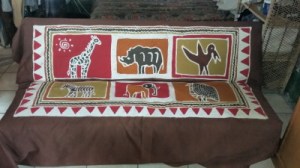
OK, OK, OK, …. ONE photo! But just because I really like the cover, and it was delivered yesterday.

Batik Cover for my Sofa

My new Batik cover for my sofa. Made to order by the women here at Penduka! The cover (not the sofa) is definitely coming back with me when/if I come back! It will fit on almost any sofa.