018_Sometimes, It Is Overwhelming

Post Title: 018_Sometimes, It Is Overwhelming
Written Date: 19 -20 March 2016
Posted Date: 20 March 2016

Somehow, that is the only title that is possible. Saturday evening of last week I was overwhelmed.  Again, last evening, my heart was so full I yearned for someone to talk to, to share with, so I wrote to my blog audience, reaching out to anyone who reads this.

Many (most?) Peace Corps Volunteers have moments where the effort and strangeness, and struggles, seem worthwhile. Some, however, get almost no sense of fulfillment while they are in service simply due to their site specifics. Unfortunately, some also can’t see the “good stuff” through the filter of the differing cultures, and things simply not going well – and there are a LOT of things that just don’t go well. In Namibia, right now, there are a lot of my group mates that have serious doubts if they are making any difference at all. The Peace Corps web site is full of stories from PCVs that only realize the impact they have many, many years later with a chance encounter, or a long term friendship. I’m fortunate here in that even though the difficulties are very present, occasionally days occur where it all seems so much more than just worthwhile. Yesterday was one of those days.

Saturday (yesterday – actually the last two weeks – more on that in a later blog) has left me swelling with an appreciation for this country, for the people I am getting to know,  and for the potential of humans that can scarcely be felt in its entirety, much less expressed. I am no writer, but I’ll do my best.

What appears below was written on Saturday night in a fog of emotional overwhelm. I’ve edited it a bit, and I recognize but don’t apologize for the raw emotional content. It may not be professional, or skillfully phrased, but it came from my state at the time – and I’m carefully retaining the feelings and memories to draw from when things aren’t as good. I’ll need them.

——————–(Below is from Saturday evening) ——————–

This morning I took the three women that run Penduka (actually two of them, plus Vistorina, a 30 year old woman who is standing in for Liina while Liina is on vacation) to a “farmer’s market/flea market” called the Green Market. It coincidentally celebrated its twelfth anniversary, today.  It has an interesting background that is held once a week on Saturdays, 08 :00-12:00 in Windhoek. (Google “Green Market Windhoek” for more information).

Penduka will start putting some of our artisan products at the market in two weeks. (The market is closed next week – Easter). It was amazing to see an ordinary thing like deciding to be at a local market being studied by Namibian women who are finding out they actually have some power in life over their own lives, and their welfare. They were very, very interested in the various booths, and surprised that one of the vendors, a white guy, vending compost (really good stuff) would GIVE them 10 kilos just because he wanted them to try it out, knowing that if Penduka ordered in bulk it would be a good sale. The women found they were an organization that others wanted to do business with and spoke with them as equals. That’s not true all the time, but it is available and is happening more often.

The woman who heads up the market, Inga (she started it 12 years ago), was very happy to spend as much time with them as they needed. Turns out (again) that Penduka was there 10 years ago- and only sold vegetables. Inga knows of Penduka and was very, very happy that we were considering returning. Penduka was not only welcomed into a limited space market, but was offered a BEAUTIFUL and large spot for our display. The women managers are entranced, and they will be successful I am sure.
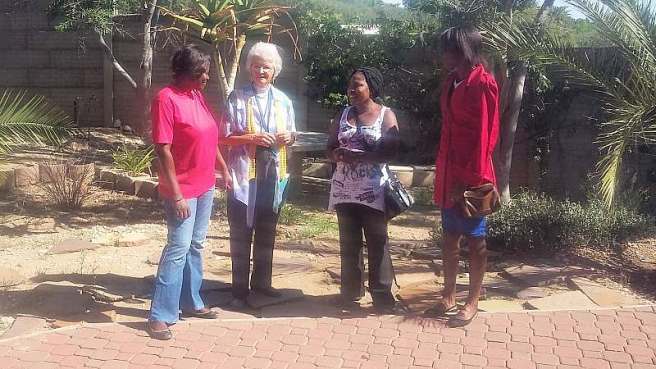
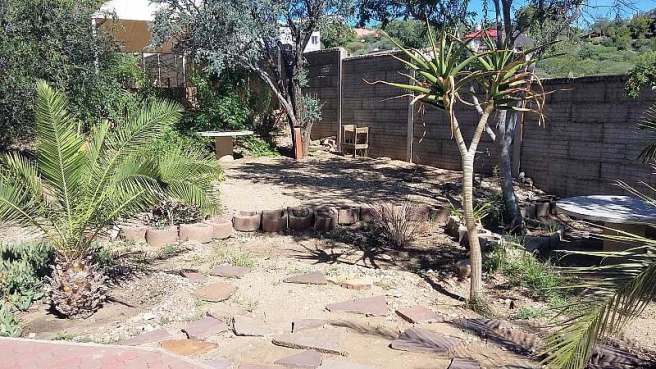
018_Green Market, Inga with GM MgrsGreen Market spot 15

Riding back, they were talking about business – planning the displays, laughing at things happening at work, and comparing notes on how they could best improve production. Most of it was in Oshiwambo and I only caught a few words. They know that’s OK with me, and they shifted into English often when it was relevant.

I got back, and an hour later was picked up by a Namibian business associate, becoming a friend, and taken to a meeting of the Katutura Youth Group. “Youth” in Namibia is defined as 18-35 (really!) and when you get to know the country it makes sense. Most of the 20 or so people there (very mixed male/female) were 25-30, with a few outliers in either direction. In the USA kids of 18 are legally adults, and think they should be treated as such. If we encouraged 25 years olds to learn something more about themselves, by and large they would take offense at us assuming they were something less than full fledged knowledgeable adults. Here, the group started with a series of exercises designed to help them learn to speak up, and to have confidence in their questions. I could write pages about the three hours I spent there, two of which were spent with me talking about the United States, my life, and thoughts on what makes a person happy at my “pensioner” age of 66. And answering questions – dozens and dozens of them.

I was amazed at the high quality of the questions. I half expected questions about Hollywood glitz, being a pilot and some such. But their questions were (a few samples): “What do black people in America think about Africa?”, “How did you feel when you were 30 about your career choices?”, “Please tell me about your life as a father, where is your daughter’s mother, and why aren’t you married, now?”, and the final question was the only one about my acting work in Los Angeles, but it wasn’t anything like “did you meet or know <famous actor>”, it was “How did acting fit into a career full of engineering, business, and lots of other things? What did you learn from acting that was useful?”

One on of the most common themes was their amazement at the social/family structures in the USA. One of them simply could not imagine making a decision that was counter to what his parents recommended – and he was over 30. The family, and community, plays a much, much stronger role in the fabric of the society than it does in the USA. There are some really great aspects to that culturally, and (like everything) there is another face to that Janus. There are some drawbacks to the strong family affiliations that keep people, and the society, from moving forward – or even deciding what “forward” means. It precludes change to some degree.

These folks are very, very bright and anxious to play a part in life that will help Namibia. I was impressed, and I told them so. If they keep going, and DO something rather than waiting for it to happen, Namibia will be fine. Who knows, maybe in 200 years it will be another USA. Hmmm – that is simultaneously a wonderful and horrible thought. I uttered a phrase while I was answering questions that I’d never said before, but on retrospect it works really well for how I feel. “I am very proud of the effort and dedication it took for the people of the United States to get to where we are now. But I am not at all proud of the state the country is in at this moment.” Sure, I could write for days on this topic, as could most of you (from differing viewpoints), but that is a pretty good summary of where I am. I will say that the people at this meeting were universally very relieved and happy that I didn’t support Trump. (If the PC reads this, we did not prolong that discussion – no politics!) They are astounded, everyone I’ve met is, that we would even consider him. ‘nuff said.

One moment that will stick with me forever – no exaggeration – was very personal. At the very beginning of the program, the leader (my friend) asked everyone to go around the circle and say their name, what is their vision for themselves, and to tell us about the thing they had experienced that made them the most proud to be Namibian. After my two hours working with them, he went around the room again and asked them each to name one thing they had learned, today. Some of them drew from our conversations, and some from other things that happened in their meeting. One young woman said “Remember the question you asked at the beginning about being proud to be a Namibian? I need to change my answer. The single most important moment like that for me, in my life up to now, is him (pointing at me). His love and dedication to Namibia makes me very proud to be Namibian.”  Wow. Sometimes I feel like my entire life has been a prelude to this work, here. The group asked me to come back and participate with them anytime I wanted (remember, I’m 66, and this is a youth group!), and they hoped I came often. I will go often.

This story is about the incredible opportunities to share, to help willing and enthusiastic people learn how to do just a little bit better for themselves and for their society, not because I know how to do it better, but because I’m simply willing to share experiences, failures, and successes over a lifetime with them so they can make their own decisions in their own complicated and varied lives to come. And these are “kids” from Katutura, one of the poorest areas in Namibia.

I found myself wishing my daughter had been at the youth group meeting – I know she would have enjoyed the company of the young people, and I think she would have been proud of (and maybe a little surprised at) her dad. I don’t mean this as a point of pride for me – it just wouldn’t have been that well received if I hadn’t felt truly humbled and flawed, and at the same time recognizing that 66 years does (can) provide a lifetime of experience that it is possible to pass on to someone. I wish I’d been able to do a better job of that with her than I could do at the time.

Unfortunately, I have no photos of the group. I may be able to get one when I go their meetings again.

One of my dearest friends/relatives has disagreed with me saying “people are the same”, claiming he/she doesn’t agree with that. In my opinion, this is not a disagreement, he/she is simply wrong. People express it differently, have different life experiences, have different values, have different LOTS of stuff, but fundamentally everyone in every culture I’ve ever worked with (and there are a lot) has been concerned for their choices, their families, and making the most of their lives. Not all of their conclusions are the same as mine, and many of their beliefs are very detrimental to MY way of life, but they are doing all they can to “get there” the ways they understand. It doesn’t mean we shouldn’t work, fight if necessary, to preserve our way of life. Some of my more hawkish friends hear my views as me being a flaming liberal, or a pacifist, or unrealistic, very naive about the world, or something equally unflattering They are wrong about me, but seldom ask what values I do live by or what I do believe.

My job, any Peace Corps Volunteer’s job, is to integrate into the community so that you can have meaningful conversations with people from another culture, and make your own experience and education available to them so they can improve themselves – not the way I think is best, but the ways they want to do it. We do, of course, hope to also open their minds to possibilities they may not even realize exist. It’s hard to make choices when your choices are very limited by your experience or conditions, or economic realities, or religion (a very significant force here). We can help to let them at least know about other ways of living, if they and their governments are willing for them to learn and grow. Some aren’t. If we can just offer that, and work to help them understand that the United States culture is not homogeneous, that not everyone lives the live of a Hollywood Star, and not everyone is homeless. Nor does the United States know best all of the time. The people here are astounded at the photos they see of homeless people in urban areas – they just don’t see how that could be possible. They need to be told that the very freedoms that make it possible to succeed make it possible to fail devastatingly. After encouraging them to DO something, to make a choice and commit to that choice not to just let it happen to them, I reminded them that there was no guarantee it would work out well. They were told about the point in my life when I was the CEO of my own company, and six months later was driving SuperShuttle in San Francisco to stay busy and earn at least a little bit of money.

I told them that I believe what works is to take whatever you have and decide to do what you can with it, as best as you can. They got it, at least for the moment. And I was (god forbid) accused of being “wise”, a left handed compliment when you are 66! I still, and often, feel inordinately inadequate. More now than before I got here. But I welcome the humility – I need it.

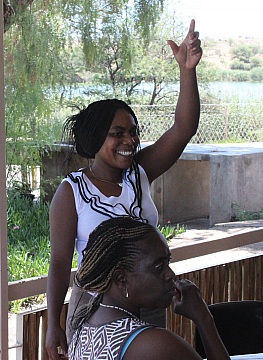
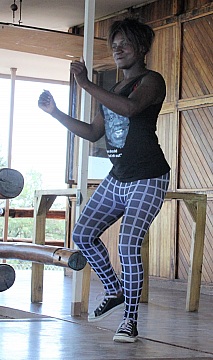
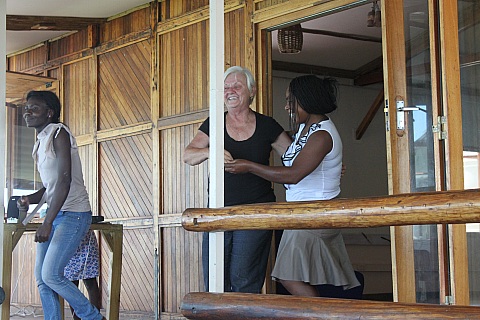
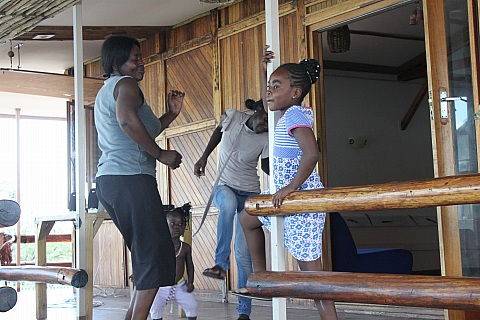
I got home feeling already so full of life and people I could hardly handle it, and was saying hello to my “family” here (they NOTICE when I’m gone, and it feels really nice when I return), when I remarked that more of the women here than usual were dressed in traditional outfits for dancing (these are cultural dances they do for some tour groups coming through Penduka). There was a BIG group of dancers tonight, and I watched this time. It was a terrific show. I simply could not stop smiling – these were my friends, and they were happy, actively and excitedly happy, to be dancing.

(I’m having a LOT of trouble uploading the Dancing video – internet here is really bad. Stay tuned and I’ll keep trying. This is a still. )
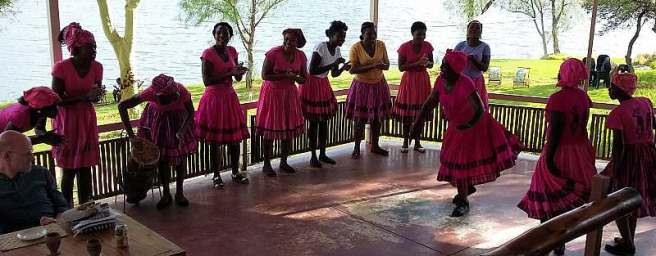
018_Dancing_160320

Shortly after I got back to my home after the dancing, out my front door a group of people were celebrating quietly but joyously. They clearly knew each other well – about 30 Namibians, almost all Oshiwambo. It was so nice, and sunset so beautiful, that I grabbed my camera and went outside offering to take their picture and send it to them. We ended up taking many pictures, and I was invited to dine with them at their braai (barbeque) celebrating the wedding party’s participation in a wedding (bride and groom hosted the party) three months earlier. I had a very traditional Oshiwambo dinner with absolutely delightful people. Lots of meats, Mopane worms, Mahangu bap, salad (small), Namibian spinach (including the obligatory sand) and South African Boerewors (sausages). One of the guests was a lecturer at UNAM (University of Namibia) in technology, and he and I are going to collaborate to bring his students to Penduka for Job Assist (intern) work improving the technologies here. I almost didn’t go out and introduce myself.

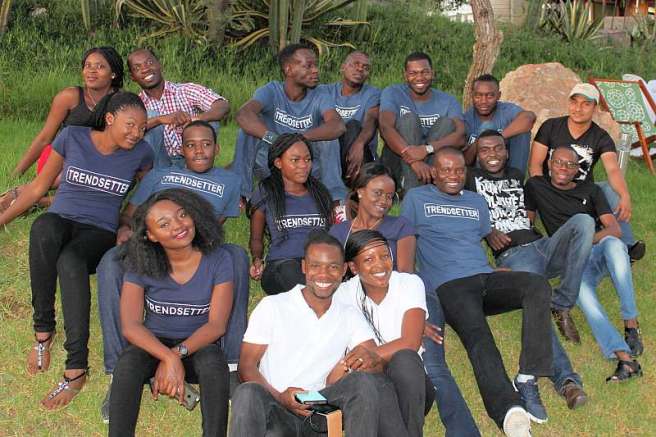
018_Elia and Rachel018_Braai for wedding party

Forrest Gump had it right – life is like a box of chocolates. You just never know what you’re going to get until you bite into it. (My apologies for undoubtedly misquoting it) Sounds maudlin if you want it to, but it’s true, and it’s wonderful. Cliff Osmond, my old acting teacher who unfortunately passed away about three years ago, said it best: “All of life, the good and the bad, all of it is there all the time all around you. It’s a matter of what you choose to pay attention to.” Rest in Peace Cliff – and thank you for that perspective.

Yes, there are days when I am so frustrated at my inability to “get through”, or to understand, that I feel completely inadequate, and I am occasionally despondent. But I never feel I’ve made a mistake coming here. Days like yesterday are woefully unavailable to many Peace Corps Volunteers during their service just due to the circumstances of their site or their own inabilities to experience what there is to pay attention to. I am very fortunate and very grateful – days like yesterday (and today, and tomorrow…) make it all worthwhile, even when they are not as much fun as today.

So I sit here typing away, will edit this in the morning (ed: yup, that’s now), and am looking forward to a night’s sleep with more peace and appreciation than I’ve felt in a long time.

It is interesting to realize that I am much closer to the end of my life than to the beginning, and I rejoice in feeling like I’m going to “go out” having felt really, really good about something I took on.
 

017_Chicks Arrived!

Post Title: 017_Chicks Arrived!
Written Date: 20 Feb 2016
Posted Date: 21 Feb 2016

Day-old chicks were finally delivered, today! (Actually 2 days old. They doubled their age while in shipping.)

In early December, the restart of the poultry program was funded with a total of US $ 488.89. The Penduka managers extend their thanks to everyone. Four of the contributors were my friends and family, but there was a fifth person I do not know that found the project and contributed a substantial amount of the total needed. Here are the highlights of the long-awaited delivery of chicks to replenish the poultry farm at Penduka.

After the project was funded, we ordered 150 day old layer chicks. There are three basic types of chickens, with many breeds. “Layers” are hens that are used only to lay eggs. Modern improvements in layers result in a planning number of 4 eggs/layer/week, and we were getting about 4.7 in November of last year. It is lower, now. “Broilers” are hens raised for meat. That’s the kind you buy in grocery stores in the chic ken section. “Roosters” are males, and can be used for meat also.

The specific breed that we ordered are “Lohman Red”, the breed we already have. When our poultry operation is operating on a rotating stock “sustainable” basis, we may start working with other breeds to see what works best here at Penduka. Our primary goal is to sell eggs. The meat is only the sensible economic and nutritional use of old layers in our business model.

The beginning of February we were notified that the chicks would be picked up by the distributor on Feb 19. This morning (Sat, Feb 20) the chicks and equipment were delivered! Some photos:

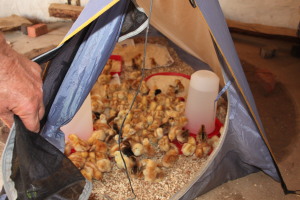
017_All chicks in the tent
All 153 chicks in their tent – home for the next 3-4 months.

Below, click on the image to see the caption. Right click and display to see a zoomed image.

Now we take care of them for 20 weeks until they start laying eggs, then we replace the existing layers: 132 remain as of today, out of the original amount of 150 chicks in October 2014.  They are beginning to show age and production of eggs is dropping. The existing layers will be used by our restaurant, and sold for meat to the community.

This was my first relatively significant (VERY small compared to things going on now!) project with Penduka, and it served as a valuable experience learning the business culture and how to get things done in Namibia. Here are some of the lessons I learned, mistakes I made, and good things that happened.

Disclaimer: OF COURSE all of what I say below does not apply to every individual. But these are widely recognized tendencies throughout Namibia, to both expats and Namibians, that are very recognizable to anyone working here.

Working with the people here:

The people are very anxious to learn and grow, and succeed.  They are very smart in what they know and what they are used to. They are a very good example of the difference between Education and Intelligence, and the role of personal drive and ambition as in any people, anywhere.

The lessons of culture started to become real to me with the Poultry Restart Program in ways that were meaningful, not just out of a book. I’m still (February 2016) learning about this every day. There is no better way to describe it that I can think of other than to say they just think differently, at a fundamental level, than people do in the cultures in the USA or the major economic countries in the European Union. The trick is to be open to that, and to understand what is going on. What seems like an arbitrary or thoughtless decision on their part, or something that flies in the face of logic, makes perfect sense (usually) when you understand what is going on in their mind. In all honesty, this is no different than working with different people within the United States, or in any culture.
In a training the other day, I hit on an example that made this clear to them in a way that really hit home – for them! I told them when I got here I had no idea how to make Marula oil. (The Marula tree nut is widely used for the oil, which is a nutrition filled fluid used often in cooking, and is also a cosmetic aid.) They had a really hard time believing this. It is so ingrained in their culture that the idea of someone NOT knowing how to do it simply wasn’t part of their reality. Then I asked them the average price of an apple if you had 2 apples that cost a total of $10. The concept of an “average” was beyond them, and they were VERY confused when we discussed one apple costing $4.00 and one costing $6.00, but the average was the same. These folks are very immediate and see a specific thing that is in front of them. “Abstract” reasoning is a very difficult thing for them. When we talked it over in training they  still didn’t get the idea of Averages, but they are least understood that to me, their lack of understanding averages was as weird as my not knowing how to make Marula Oil was to them!

By the way, they taught me how to make Marula oil since then. If you find yourself running short of Marula oil in the kitchen or vanity, let me know and I’ll tell you how to fix some up from the nuts on your back yard Marula tree. Just be prepared to do a LOT of pounding a heavy stick.


Doing business here:

It has become a “given”, at least to me and everyone I know of that lives or works here, that phone calls or emails won’t be returned on time, or at all. There are very happy exceptions, but they are by far the exception.
Appointments for a specific time are virtually meaningless unless the people involved are younger and work in an urban setting and even then arriving on time doesn’t happen often. Time simply doesn’t have the same meaning here, and I still don’t quite understand why but we have some theories. Maybe more on that in a future blog. I’m happy to say it doesn’t drive me crazy any more – it’s just “that way”. It is frustrating at times, but what is interesting is that it is ALSO frustrating to the people here! They are just used to it.

Personal Responsibility:

The idea of being personally responsible for what you agree to do is also not a commonly accepted thing. “Accountability” as a concept is equally strange and new. To the managers and staff here, they don’t resist it, but they just don’t get it!

The beginning of February we started a training program for the four senior managers and this topic is one of the first we are taking on both explicitly and implicitly in the training programs and the way the company is being structured. Wish us luck!


So – I have to stop here. By tomorrow I have to have (1) A proposal for well over NAD $100,000 to build a greenhouse for a new Aquaponics installation (more on that later, also), (2) A financial summary for 2015 including 2016 budgets so the Board of Trustees can hopefully approve a very modest salary increase for some of the staff, and the need to hire some new people, (3) A different proposal document with executive summary of Penduka for another project we are seeking to fund through a Namibian organization, here, (4) several smaller projects that must be completed by tomorrow to even be useful.

This is a VERY busy job, but it is part of today’s Africa. I love my job, but it is sometimes exhausting.

As always, please “FOLLOW” this blog. Button is on the lower right corner. It helps me know who is reading, and it is an encouragement for me to post a new blog.

Andy

016_A couple of days around Penduka

Post Title: 016_A couple of days around Penduka
Written Date: 10 Jan 2016
Posted Date: 14 Jan 2016

If you are willing, please “follow” these blogs (button on the lower right corner) and you get an email when I post a new blog. It is encouraging to me, and does some minor good with WordPress (hosting this site). And it’s OK if you don’t, of course. No ads or mailing lists will follow.

I had a really nice SKYPE with my family the day after Christmas (my time) when they had just finished Christmas Dinner in California. Delightful! It is so nice to be in touch with family. My understanding of what a family brings to life has been evolving the past several years, and especially noticeable (at least to me) in this part of life in Namibia. I’ve never been great about staying in touch – an old family tradition in my opinion. But I’m working to be better at it. A lot of the reason for that is realizing how much people can mean to each other, and special ones (family) have a place in the heart that is hard to describe.This place is changing me.

Family is a mixed bag, of course. There are “not so fun” parts as well as the “really great” parts. But the overall experience is – well – one I’m glad to have started to understand and take part in as I grow older. I wish I’d been able to express it more fully over the years to my own family, and daughter, and to people I care so much about. There are some people I really would like to hear from, it’s lonely over here. But it doesn’t impact how I feel about them.

I miss people, but I – honestly – don’t miss being in the USA at all. Sure it helps that I have a nice place to live, but as much as I love Sausalito (it is more of a home than I’ve felt since I left Dallas as a 17 year old kid) I like being here, wherever “here” is. I guess that’s just in my blood.

This blog is about photographs and people – drawn from two not particularly important days in the last month or so. Just so you’ll get a flavor of who I work with here, and what they are like. It is indicative of life here at Penduka, but not “typical”. It’s just a shot in time – not a complete picture.

Since there are an increasing number of photos, I feel obligated to point out the obvious – I am NOT a professional photographer! And unfortunately one of the key aspects of the technical skills is that the black skin of most of the people here simply doesn’t show up as well in photographs, even with “fill in” flash. I’m working on it, so forgive my inability in some cases to properly show the expressions that make good personal photos. Especially Kauna. You’ll see more, and better, pictures of her as I blog.

17 Dec 2015: The Christmas Party for the staff.

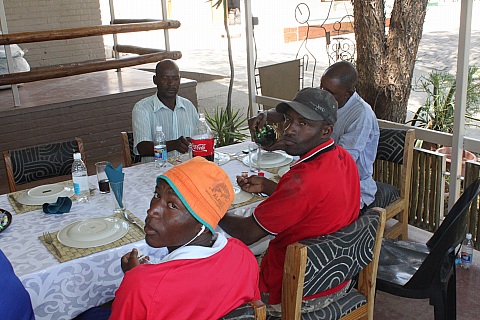
Most of the 33 people of Penduka went on holiday Dec 18 for at least two weeks, so on Dec 17 we had a lunch/party.

 016_Dinner Group 1016_Dinner Group 2


One of my favorite people in my entire life is Kauna – the “new” General Manager of Penduka. I work very closely with her trying to make available whatever experience and skills would be useful to her as she struggles to bring a Namibian style order to the chaos of Penduka. It is a very, very tough job. This is the first time Penduka has a Namibian General Manager promoted from within. She is invariably upbeat, and very capable. She simply lacks the experiences and training that most of us from other cultures have along the way. She is already a very good friend, is a valued colleague, and I value her and our professional relationship, and respect her, more than I can describe here. You’ll hear more about her, and the Penduka structure, in following blogs. Christofine is at the bottom of the picture. She is totally deaf and works in the sewing department.

 016_Kauna &amp; Christofine


Just before lunch, finishing a large customer order – pretty much everybody from every department around the table installing drawstrings in Penduka produced bags for a Safari company here.  It was an amazing “team” experience for everyone. This group is starting to pull together.

016_Women installing drawstrings

Lots of laughter and jokes – wish I spoke better Oshikwanyama, or Afrikaans, or Herero, or Oshindonga, or NSL (Namibian Sign Language). My German actually helps a little bit (not in this room, but around Namibia).  This is Leena (not the same as Liina) just after telling a joke I didn’t understand at all! She works at the Namibia Craft Center in Windhoek downtown, selling Penduka items to tourists. She’s probably going to start working back at the Village soon.

016_Leena after joke

And below, Just after lunch, checking out the sales ads: From Left, clockwise: Elizabeth, Leena, Diina, Sofia, Kahaka, Helena (on this side of the table).

016_Checking out the sales

Kambalantu with Grace (not his daughter). Grace and all of the kids that show up here regularly are a great example of raising children by a village. The kids are taken care of and loved by whomever happens to be near them. Including me!

016_Kambalantu &amp; Grace

Kambalantu I’ve mentioned before. He was a freedom fighter (literally a revolutionary!) in the war for independence from South Africa that resulted in independence in 1990. Doesn’t look like a guy that carried an AK-47 supplied by Castro for 14 years, does he? He is a GREAT guy – and the driver here at Penduka. Consider for a moment our “forefathers” in the USA. Same deal if you were living in 1800. A neighbor and friend.

David (below with some grey/white haired guy) is the supervisor of the guards, takes care of the poultry farm and garden, grounds maintenance (mowing, etc.) and maintenance on site. Very hard working, and works as a part time policeman for Katutura on the rare evening he isn’t fixing up Penduka.

016_David and me

The four guys (all the males except me!) – Top Clockwise: Leonard, Kambalantu, David, Fillipus

016_Leonard Kambalantu David Filippus (Top CW)

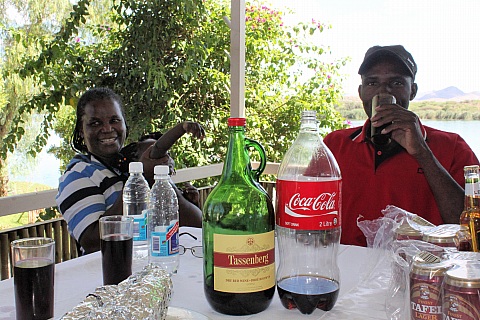
And now something I don’t get AT ALL! It’s a common thing here to have dry red wine with Coke. Go figure. They say it makes the red wine sweeter. Yes, I tried it. If I can eat mopane worms, I can try this. I prefer mopane worms.

016_Liina David Coke &amp; Wine!!!!

And, of course, with only minimal alcohol and no music at all: Dancing! This is Rebekka – stone deaf since birth. Who needs music to celebrate?

016_Rebekka_Dancing

Below: Hilini (Grace’s mom), Jenny and Kauna. Still no music.

016_Dancing 2

Victoria, and Kauna’s daughter, Selma. (Hilini in the background). Aw, who needs music, anyway, when you’re among friends?

016_Dancing 1

23 Dec 2015: The impromptu PCV Christmas Dinner for our unfortunate colleague from Zambia.

Just before Christmas, I had to go into town to get a Peace Corps Volunteer from Zambia that was robbed of passport, money, phone, everything. She was not hurt at all, fortunately. I put her up at my home for a few days until the Peace Corps could get her back on her feet so she could finish her vacation. This is Christine (“Teen”) just before we started dinner.

016_Teen

Teen tells me there are about 300 PCVs in Zambia, and they are ALL in very remote areas! Zambia is only slightly larger than Namibia, but it has 15 million people (Namibia has 2.3 million if you use a generous estimate). The Zambian projects are Education (that’s what Teen does), Agriculture and Fish Farming (raising fish for protein). As a reference the Namibia projects are CED (that’s me, Community and Economic Development), Education and Health. And we have about 140 PCVs in Namibia.

The taxi driver that day was David (PCVs world wide are not permitted to drive at all) – I’m getting to know him, and a few other drivers, pretty well. Somebody remind me to write about taxis here – it is a VERY different “system” than the USA. David owns a farm with a lot of “cattles” (that’s their word for what we call cattle) in his farm with his family in Northern Namibia. His cattles are dying, literally, because they have nothing to eat. The drought is devastating life for a lot of people here.

016_David Taxi

That evening, a bunch of PCVs from Namibia who were in town got together with Teen (Zambia) so she would have at least an impromptu Christmas dinner. On the Penduka patio, from left clockwise: Cristal, Donna, Christine (“Teen”, Zambia), Mariah, Daviun, Gail.

016_Impromptu PCV Dinner before XMas

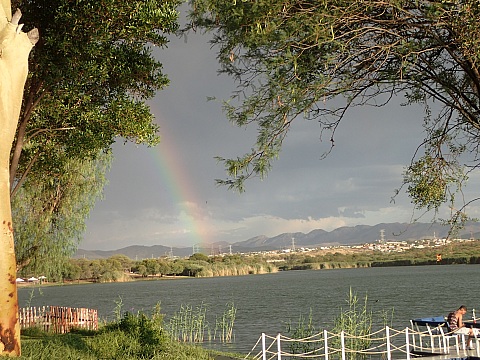
A little earlier, there was a beautiful rainbow over the eastern part of the reservoir (picture doesn’t do it justice).

016_Rainbow

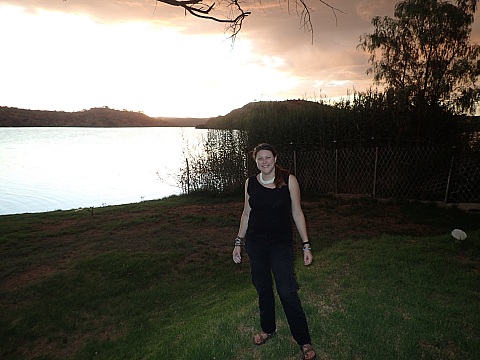
And a little after dinner started: Sunset. Just a normal one for Africa.

016_Sunset

Yes, I love it here. And I miss you all. Please write or comment. As wonderful as it is at times, it is a LOT of work, and it gets lonely, socially.

Love to you all,

Andy

Postscript:

I’m watching an episode of “The Newsroom” relaxing after spending a few hours putting this blog entry together. Yup, that’s how long it takes, at a minimum. At least for me. How I wish I could write like Aaron Sorkin! Sigh.

015_Chicks and Thanks

Post Title: 015_Chicks and Thanks
Written Date: 18 Dec 2015
Posted Date: 21 Dec 2015

Forgot to post this before I posted the longer blog yesterday. Sorry!

THANK YOU to everyone who contributed so generously to the Egg Farm Restart project mentioned in post 013 a little over a week ago. A few of you let me know you had contributed, and I think I responded to everyone that did. There were some donors that did not identify themselves at the time, and the list of donors (unless you opted to stay anonymous – and I hope you didn’t!) won’t get to me until the funds are deposited in about another week or so – after federal security steps have been followed.

Some of you were incredibly generous – thank you so much! I know it wasn’t much money overall, but it was less than a week from posting until I was notified that the goal was reached! That is really, really rare even for a small fund raising effort.

Now we are just waiting for the chicks – and they have been ordered. Since the entire country virtually shuts down for the two weeks around Christmas and New Years, it will likely be January before the chicks are delivered. But we have the food, the space to raise them, and are ready whenever they come.

Pictures and updates will be posted on this site periodically.

Now a request, if you haven’t already done so, would you please FOLLOW this blog site if you are interested in the material? It helps me out a little bit with WordPress (hosts the site) and will give you email notification when I’ve posted a new blog. See the button in the lower right corner of this screen.

The women of Penduka were aware of the effort, and were told that the goal was reached and that we are getting the chicks soon. They were VERY excited and thankful. thank you very, very much for your generosity! You have helped to make a little bit of difference for them.

Andy


014_The “real” Africa? What’s in it for me.

Post Title: 014_The “real” Africa? What’s in it for me.
Written Date: 19 Dec 2015 – 20 Dec 2015
Posted Date: 20 Dec 2015

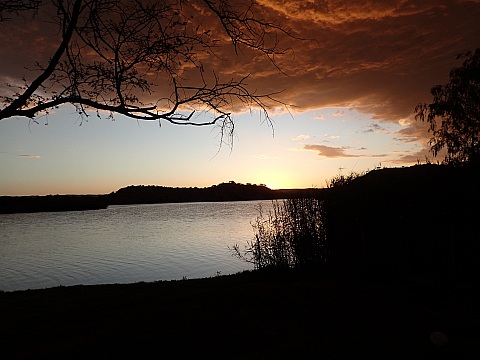
The theme of “What is the real Africa?” will probably come up fairly often as I muse in this blog over the next few years. After eight months in Namibia, the topic isn’t as immediate as it used to be, however. There is a sense of just being “here” without trying to figure it out or assess it. I like realizing that it only comes up once in a while, now. I’ll be sitting quietly enjoying the sunset, or the wind on the lake, or the city buildings rising around me, or the stars, when it occurs to me “Damn, I’m in AFRICA! These are the stars in the Southern Hemisphere!” with the capital letters still flashing in my mind.

Sunset

At some level it still feels exotic – but I’m getting used to it, and I like that. I’ve been under the Southern Cross fairly often in my life, but never actually living there / here.

And it’s not all that different. Except it is.

Okahandja Tower

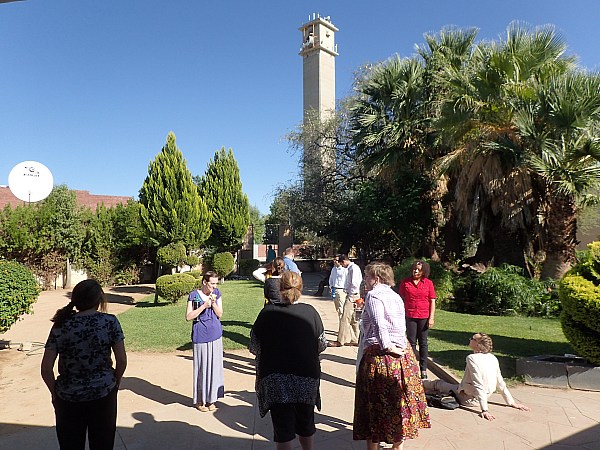
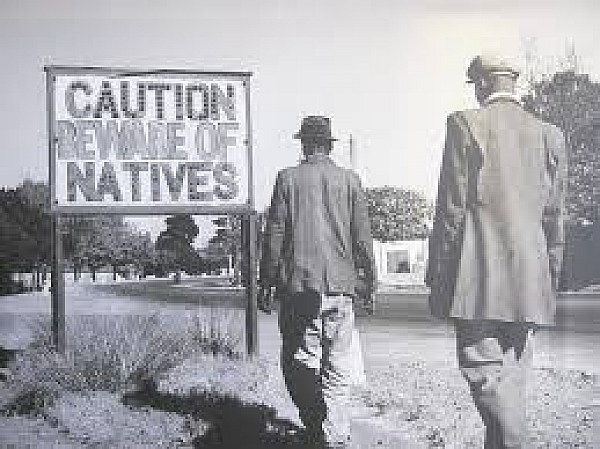
In Okahandja, there is a beautiful community center where my group (41) of Peace Corps Volunteers met for two months during Pre-Service Training. There is a distinctive communications tower prominent in the middle of the city. After several weeks, I discovered that the tower used to be a watch tower during Apartheid – where the communities would be observed to make sure no one from one tribe (Wambo, Herero, Damara, Nama, Colored, Bastars) went into the area of another tribe. Apartheid – literally “holding apart” – segregation pure and simple, and a way to control populations by not permitting them to cooperate, and keeping them uneducated and incapable. And I have met a very few people here in Namibia (not surprisingly, white) who adamantly defend Apartheid to this day. “Things worked so much better!”  It is impossible to overstate the subtle and fundamental ways in which the colonization and subjigation of these peoples have affected their culture and ability to learn and be self-reliant. It was, and the effect still is, insidious. And no, I didn’t take this picture.

Beware

In writing this blog, I was struck by a phrase found in a Master’s Thesis by a Namibian doing his work on “Herero Mall” in Katutura. The thesis is by Ellison Tjirera, 2013, from the University of Namibia. “Things are not as they seem, and what you see barely represents the ‘truth’. Such is the nature of social reality and meaning. The challenge is to transcend mere observation.” I’m not sure I feel qualified to transcend, so I am stuck with mere observation with a liberal dose of introspection.

My own experiences here are unique – but then I’ve come to really understand that everyone’s experience is unique, everywhere. I haven’t seen the lions, giraffes, hippos, incredible sand dunes, magnificent vistas of the savannah, village people (the real ones, not the ones manufactured by the entertainment industry) beating drums and dancing around a fire, herds of Wildebeest racing to escape a predator, or crocodiles grabbing a careless (or young) Kudu stopping for a drink at a water hole. But I have seen some African animals.

Gryffendore

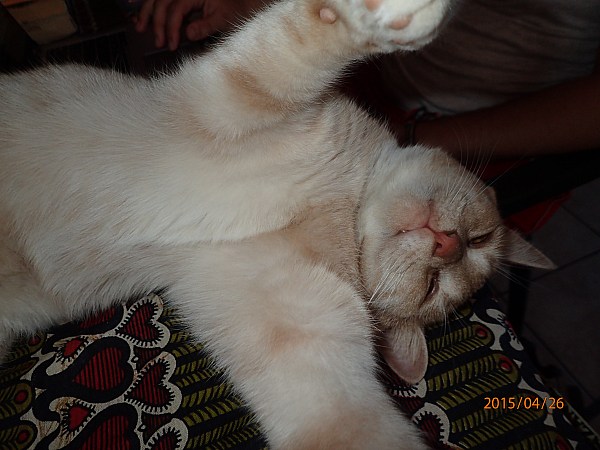
This is Gryffendor – an African feline belonging to Alicia, a PCV in Okahandja. Alicia is now back in the USA, but Gryffendor is terrorizing the home of Val (AKA: Veronica). I can’t remember the last time this predator pulled down a Water Buffalo, but it may come back to me.

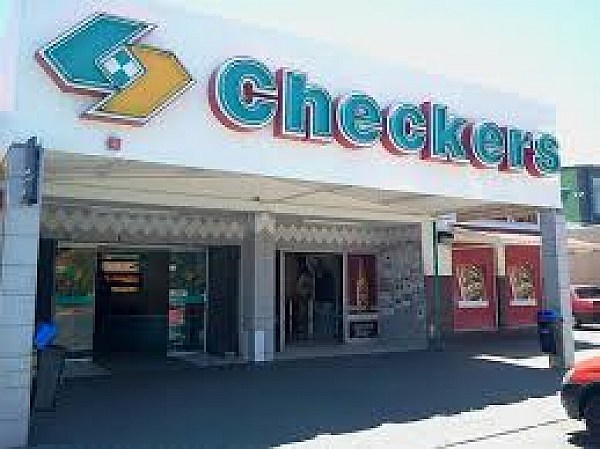
Come to think of it, most of the mental images of those “African things” come from television or magazines and a few movies. All of which are interpreted with a liberal dose of entertainment value that by economic necessity ultimately supports the efforts of the image makers. But I do have Kudu steaks in my refrigerator, and Oryx. And it’s no big deal, here. They are available at the supermarket. And I’ve eaten crocodile, and Mopane worms (which are really caterpillars, and are very good with spices, and highly nutritious), and both are also available as staple diet items in supermarkets like Checkers, Spar, PickandPay, Shoprite, and other stores that look very much like the grocery stores I am used to in California. Of course you can also get them at “Tuck Shops” – the little shacks outside of a home that offer things to neighborhoods but they aren’t nearly as fresh and should be purchased with caution. Being in Windhoek, I have such modern stores much more easily available than do my friends in the villages.

Checkers

Yup – this is Africa, too.

But some of my Peace Corps friends here have seen the things most of us identify with Africa, and much, much, more.

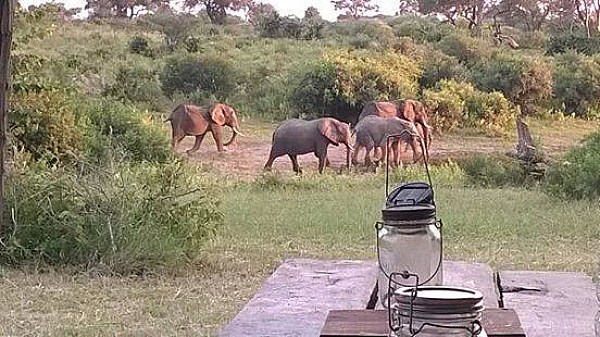
Elephants at breakfast

This is the first of two photos that I didn’t take. My friend Scott Richmond was sitting at his breakfast table and took this – really.

Some PCVs live with the Himbas, where women are topless ALL the time – it becomes no big deal. It is their traditional way of dressing. Some live with villagers that have never seen a white person (really! still!) although I occasionally meet a small child that is wide eyed and scared of me because their parents tell me they’ve never been this close to a white man, much less one with white hair and a beard! And they have seen the wild animals, and the sand dunes, and the beauty of Namibia and surrounding countries.

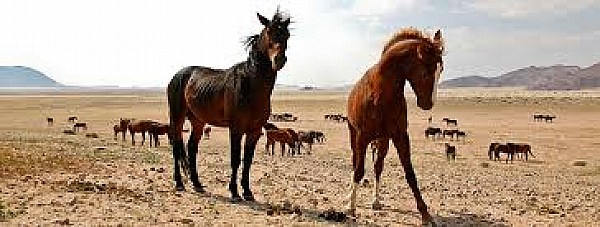
wild horses

But I have seen wild horses scattered haphazardly across the Kalahari Desert, which has a lot more grass, bushes, and hills than I expected.   (Full disclosure: This is the only other picture that isn’t mine. I have one, but the horses are a LONG way away and this one’s from the internet. But they did look like this! The trip I saw horses was the one where I learned to always have a camera easier to get to while in this country. )

And I’ve seen scattered herds of urban Africans bustling around the capital city trying to survive, or get richer, or help their fellow Africans, or take advantage of someone, or look for their next mark to rob, or support their families by washing the windows of someone else’s office who is trying to do one of those things.

Somehow, in spite of all of the travelling I’ve done over the past 66 years, about 77% of which I was old enough to remember fairly well, the incredible complexity of life on earth, and of the human mind, is becoming a reality to me in a way it never did before. I have visited far fewer countries than many people (my friend Vassi being a very good example), more than most (about 45 countries at last count that I’ve lived, worked in, or visited not including airport stopovers), and that’s only about 23% of the nations recognized by the United Nations. Increasingly I understand at a fundamental level the incredible reality of realizing all that I do not know, and will never know. No wonder people have spent their lives searching for a Fountain of Youth. To me, it’s not about the vanity of wanting to remain young, it is about all there is to experience, and what a paltry portion of that I have enjoyed even with a relatively active life full of choices to “try it out” rather than “increase/build what I have.” There was a price to pay for those choices, and there was benefit that I’ve enjoyed. I’m happy to say I’m pretty satisfied with the balance from this viewpoint in my life. Although there were times …

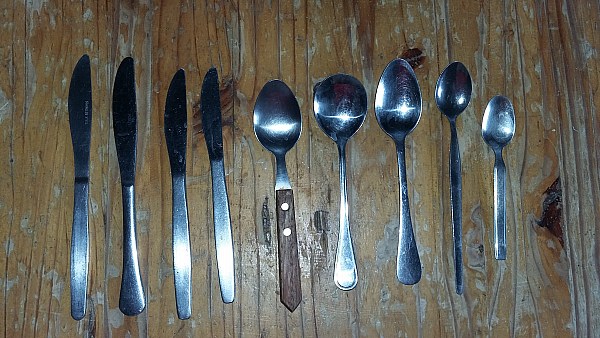
In my home, I notice I don’t mind that I have six (oops, two of them seem to have disappeared) FOUR table knives all but two of which are of different types, and all are old and steel. And the spoons speak for themselves.

Tableware

The background is my dining table top – before refinishing. I’ll show an “after” photo when, and if, it ever happens. My furnishings here are rough, almost all of them second hand but perfectly functional, and I’m still wearing the same shirts/pants/socks/underwear I came over here with. Yes, I’ve washed them – often!

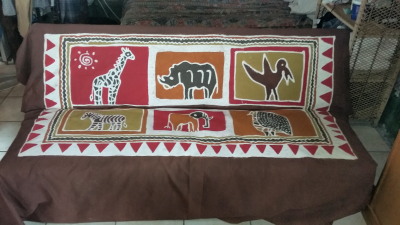
But compared to the people I live amongst, I have easily 10-20 times the physical possessions they do. I just bought my first piece of clothing, here – a pair of khaki shorts, well made, and they will give me years of good use. I did get them on sale. Just like any store in the USA, businesses here have “promotions” (a much more common term). I have two new items: an office chair, and a fold-out sofa (so I’ll have a place for visitors to sleep, but there have been very few of them, fewer than I had hoped). The sofa now has a beautiful custom made Batik cover that was hand made by my friends here at Penduka.

Batik Cover for my Sofa

The design was made by Victoria (large photo on the left), and the sewing done by Kaino (upper right) and Kahaka (middle photo on the right), and maybe someone else. Jenny (lower right) was instrumental in getting it done. Jenny is leaving us the end of January, and will be greatly missed and very hard to replace. These women are my friends, my “family”, and I see and work with them daily. All but four of the 28 women here are away on holiday leave to their home villages, and I find I miss them a lot! Kahaka sewed a bag that goes at the base of my door to keep out the cold, and snakes! She did it on her own and brought it by, today, just to be nice.

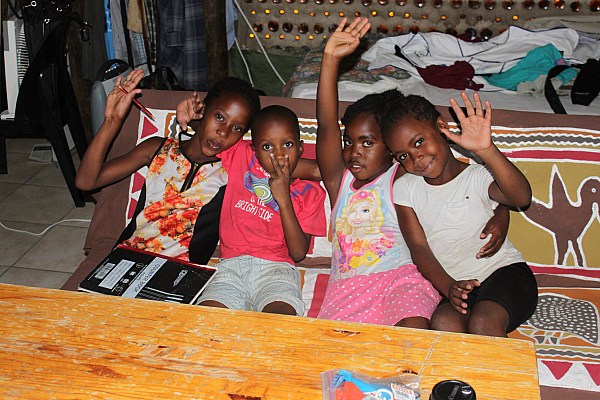
But I prefer to see my sofa as it is below (ignore my bed in the background!) All are kids of the women, here, and they love to stop by my place.

Kids on Sofa

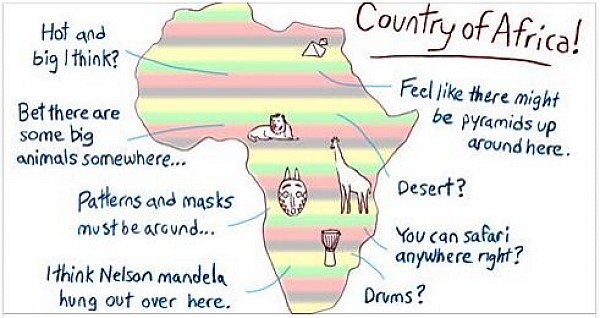
People see Africa in many different ways. Here is just one of them.

Map of Africa

My view of Africa is limited to Namibia for the past eight months, and two weeks in Tunisia 40 years ago. Namibia is 2.7% of the area of Africa, and I’m a little familiar with the cities/towns of (in decreasing familiarity) Windhoek, Okahandja, Rundu, Aus, Keetmanshoop (just a few hours and a hell of a good travel story), and a few km either side of the highways between them. Let’s be generous and say that’s 2% of the area of Namibia, which means I’ve seen 0.0054% of Africa. Oh, wait! Don’t forget Tunisia! Hmmm, turns out that the parts of Tunisia I’ve seen don’t even add 0.0001% to my total Africa experience if we go by land area, even though I went deep into Tunisia to Hammamet on the edge of the Sahara. To try to explain what Africa is like would be hubris.

But I have been to the Plains of Carthage where the Roman General Scipio Aemilianus Africanus burned the city to the ground in 146 BCE and left no stone on top of another. (Turns out the “salted the earth” story is a myth.) And I have Herero and Nama friends who remember talking with grandparents who lived through the German genocides of those tribes in the early 20th Century when Southwest Africa (Namibia) was a colony of Germany. It was a kind of training and practice session for the Jewish Holocaust in WWII, but a lot less well known.

My home and work is part of an effort to help low income and disadvantaged/disabled women find their self-respect and self-confidence after hundreds of years of colonial rule. And my neighborhood is made up of people (not a few of them – almost ALL of them over 25) who lived through Apartheid, personally.

One of my friends is now a driver for Penduka and was a resistance fighter for SWAPO in Southwest Africa for 14 years fighting for independence from South Africa in the latter half of the 20th century. Kambalantu isn’t a newspaper, book, or magazine article, he is a man and a friend, he was a revolutionary, and we talk about his experiences regularly.

Liina is discovering in the past six months that she has the capabilities to be an exceptional leader and manager, and she spent the first 35 years of her life as a black woman under Apartheid. About half of the women here spent at least half of their lives being actively prohibited from getting a good education, from gathering with others, and being punished if they tried to exhibit self-determination. And they are working, together, to become something better. And, slowly and imperfectly as is every human endeavor, they are succeeding.

The “real” Africa? Haven’t a clue. But the little corner of Namibia with which I am becoming familiar, and the people I am learning to know and understand, and appreciate, and love, are without a doubt creating an experience in my life that is matchless. I hope I am able to provide them with some very small part of what they want and need to better their lives. They exhibit, daily, the desire and willingness to work for it. It reminds me of what I read our forefathers were like in the USA when our nation was only 25 years old. What this experience, and the people here, offer me is so very much greater than what I am able to contribute.

Maybe that is what Africa does to everyone. I’m hardly the first.

I would appreciate it if you would “Follow” this blog if you are interested. See the lower right corner of the screen. Thanks for reading.